
Market experts on why the bulls will be on the rampage first thing on Monday after the scrapping of enhanced surcharge on FPIs and other measures to ease the systemic liquidity squeeze and boost demand. Prasanna D Zore reports.

India's current limit of $25 billion for ownership of government bonds by FIIs is fully utilised, leading to calls for increasing it

FIIs pump in $1.4 billion in March, after pulling out $2.9 billion in Jan-Feb.

The wider NSE Nifty too fell by 61.40 points or 0.57 per cent to end at 10,618.25.

The 50-share NSE Nifty slipped below the 10,700-mark and finished at 10,679.65 -- down 38.40 points, or 0.36 per cent.

The global brokerage firm believes that CRR cut is likely to help cut lending rates and revive growth sentiments.

The market proved tenacious in afternoon trades on buying interest in Old Economy and FMCG stocks. In addition, renewed buying was observed in banking stocks.

The wider NSE Nifty too fell by 20.15 points or 0.19 per cent to end at 10,749.75.

Kotak Bank was the top laggard in the Sensex pack, shedding over 2 per cent, followed by ITC, PowerGrid, M&M, HDFC, Asian Paints and NTPC. On the other hand, Maruti rallied over 4 per cent. Bharti Airtel, Axis Bank, IndusInd Bank and Bajaj Finance were also among the gainers.

There will very little direct impact from the US Fed's rate hike this time, as we are well prepared both to handle liquidity, outflow of FII funds and managing our currency. But that doesn't mean India will be out of the woods anytime soon, says M V Subramanian.

In the entire 2017, FPIs put in a collective amount of Rs 2 trillion in equity and debt markets

Two senior ministry officials, who declined to be named, said the aim was to attract more capital flows from wealth funds in West Asian countries.

'Life will not improve overnight; it will happen in a gradual manner.'

Investors are anxious over the US-China trade tension, a sharp devaluation in yuan and uncertainty over Kashmir issue.

On the macro front, market participants will closely watch the FY'15 fiscal deficit target

Tata Steel was the top loser in the Sensex pack, sinking over 5 per cent, followed by SBI, IndusInd Bank, Bajaj Finance, HDFC Bank and NTPC. NSE Nifty tanked 371 points to 16,614.20.

Falling for the third day, Indian rupee on Wednesday weakened by 14 paise to close at over one-week low of 62.02 against the Greenback.

The Budget has to provide for capex on roads, railways, defence and other infrastructure sectors.

Foreign institutional investors pulled out Rs 86.66 crore (Rs 866.6 million) from local stocks on Monday, as per provisional BSE data.

US Fed rate rise raises risk of further drying up of FII flows.

Hiccups in Chinese economy and the overall strength of the dollar will continue to be a drag on the rupee in the coming year

The view among the regulator and the government is that the currency is overvalued

The currency lost six paise on sustained dollar demand from importers.

Indian benchmark indices may witness bouts of volatility this week as traders roll over positions in the derivative segment on expiry of near-month contracts, say experts.

This time, RBI can cut rates to reflect the improved fundamentals and to further shrink the arbitrage window.

Experts believe volatility is here to stay for some time, at least till China stabilises and clarity regarding the US Fed's interest rate move emerges.

The new norms provide an operational framework for FPIs, a new class of overseas investors that club all existing class of investors like foreign institutional investors and Qualified Foreign Investors.

Rupee movement, global cues key for stocks this week: Experts

It can be noted that the rupee lost nearly 7 per cent since the beginning of May as FIIs have pulled out nearly $4 billion from the domestic debt, as bond yields fell on expectation of RBI cutting rates on Monday.
.jpg)
Else, more capital outflow and pressure on rupee likely.
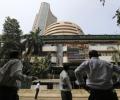
Other losers included HCL Tech, Yes Bank, IndusInd Bank, TCS, ONGC, Bajaj Finance, PowerGrid, Vedanta, Asian Paints, NTPC and Hero MotoCorp, which shed up to 4.07 per cent.

The rupee had shed one paise to end at one-month low of 61.74 against the US dollar in Tuesday's trade.

'...and defensive until the global macro headwinds turn more benign.'

The rupee recovered from more-than three months low of 63.15 in early trade on dollar selling by banks.

So long as there are concerns about world trade, growth and oil prices, the domestic market will remain volatile.

The rupee's fall against the dollar is bad news for companies which have increased their exposure to foreign currency loans in recent years.
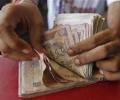
The rupee resumed higher at 61.13 per dollar as against yesterday's closing level of 61.40 at the Interbank Foreign Exchange and strengthened further to 60.90 per dollar before ending at 61.05 per dollar, a gain of 35 paise or 0.57 per cent.

On Wednesday, FIIs sold shares worth Rs 1,573 crore.

NSE Nifty, after shuttling between 10,809.60 and 10,725.90, finished 30.95 points, or 0.29 per cent lower at 10,741.10.

If net forex outflows turn out to be relatively high in the next few years, the rupee could depreciate beyond Rs 80 to a dollar by 2022. The causal reasons could, for example, include unmet expectations of FPI and FDI investors about the performance of the Indian economy, sharp rise in prices of imported oil and decrease in FX remittances. The RBI has to ask itself whether guaranteeing future rupee-dollar exchange rates on FX forward contracts is a reasonable way to use its risk-bearing capacity, says Jaimini Bhagwati.
